Stay ahead of evolving cyber threats with expert-driven content on cybersecurity, IT compliance, and data protection — specifically for businesses operating in Cyprus. This category covers threat detection, ransomware prevention, firewalls, risk audits, and regulatory standards like ISO 27001. Whether you’re an SME or enterprise, our guides and case studies help you secure your infrastructure, train your team, and meet EU cybersecurity requirements. Learn how to protect your data, reputation, and bottom line with proven strategies from industry-leading partners like Fortinet and Palo Alto Networks.
Why You Need Data Breach Incident Response Before Disaster Strikes
Imagine walking into your office on a Monday morning. You pour your coffee, sit down to check your emails, and try to log in. But instead of your desktop, you are greeted by a red screen with a countdown timer and a demand for 5 Bitcoin.
Panic sets in. You cannot access client files. You cannot process payments. Your email system is dead.
Understanding the need for a solid data breach incident response can save your business from irreversible damage.
This is not a scene from a Hollywood movie; it is the daily reality for thousands of businesses globally. And the aftermath is often fatal. According to widely cited industry statistics, 60% of small businesses fold within six months of a significant cyber attack.
At ACE Networks, we operate on a simple, foundational truth: We Secure What Matters Most – Your Business. But to protect your legacy, you first have to understand exactly what is trying to destroy it.
Implementing a data breach incident response plan is essential for every business.
The Myth of “Too Small to Hack”
The most dangerous sentence in the modern business world is, “I’m too small to be a target.”
Preparing a data breach incident response is crucial for minimizing risks.
This mindset is a fallacy. Cybercriminals do not just target Fortune 500 companies. In fact, they actively hunt small and medium-sized businesses (SMBs) precisely because they often lack enterprise-grade defenses. To a hacker, your business is “low-hanging fruit.” They aren’t looking for a challenge; they are looking for a payday.
If you lack robust Small Business Endpoint Security, you are essentially leaving your digital back door unlocked. Hackers know that SMBs often possess valuable customer data—credit card numbers, personal identities, and proprietary information—but have fewer resources to protect it.
Modern endpoint security goes beyond simple antivirus software. It involves sophisticated Endpoint Detection and Response (EDR) tools that monitor behaviors and stop attacks before they execute. Without this layer of defense, you are invisible to the enemy until it is too late.
The Anatomy of a Collapse: Why Businesses Fail
Why do 60% of businesses fail after an attack? It isn’t just the ransom payment that bankrupts them. It is the “death by a thousand cuts” that follows:
Without a data breach incident response plan, the consequences can be devastating.
A well-structured data breach incident response can prevent reputational harm.
Operational Paralysis: If your servers are encrypted, your revenue stream stops immediately. How long can you pay staff, rent, and vendors if you cannot bill customers for weeks?
Reputation Damage: Trust takes years to build and seconds to break. If you lose client data, you often lose the client. In a tight-knit market like Cyprus or the UK, word travels fast.
Regulatory Fines: Non-compliance with data protection laws can lead to massive fines. ACE Networks helps you navigate complex IT frameworks to avoid these penalties.
Without a strategy for business continuity, a single click on a phishing link can turn into a liquidation event.
The Critical First 48 Hours: Data Breach Incident Response
When the worst happens, speed is the only thing that saves you.
Most businesses panic. They unplug servers, delete logs, and accidentally destroy the evidence needed to recover their data or trace the intruder. This is where a professional Data Breach Incident Response plan becomes your lifeline.
Establishing a data breach incident response team is vital for timely recovery.
An incident response strategy is not just about “fixing computers.” It is a specialized, military-grade procedure designed to:
Training employees on data breach incident response is essential for overall security.
A proactive data breach incident response can mitigate the impact of cyber threats.
Contain the threat immediately to stop the spread across your network.
Eradicate the malicious actor from your system.
Recover your data from secure, immutable backups.
We leverage innovative IT solutions to optimize your operations, ensuring that if an incident occurs, your response is calculated, rapid, and effective. If you don’t have this expertise in-house, you are fighting a wildfire with a bucket of water.
Our focus on data breach incident response ensures swift action when needed.
The Insider Threat: It’s Not Always a Stranger
Recognizing the signs of a breach early allows for effective data breach incident response.
While we fear the anonymous hacker, sometimes the threat is closer to home. Insider Threat Detection is a critical component of a holistic security strategy. Whether it is a disgruntled employee or a well-meaning staff member who accidentally exposes credentials, the risk is real.
Don’t underestimate the impact of having a strong data breach incident response in place.
This is why Unified Communications and secure collaboration tools are vital. By implementing systems that streamline communication channels while maintaining strict access controls, you reduce the surface area for error and internal compromise.
ACE Networks: Your Insurance Policy Against Bankruptcy
You wouldn’t run your business without liability insurance. Why would you run it without a cybersecurity partner?
At ACE Networks, we don’t just act as another IT provider; we are a dedicated partner committed to helping you achieve your business goals. We help you build a Future-proof IT Strategy that includes:
Scalable Solutions: We implement security architectures that grow alongside your business, so you never outgrow your protection.
Cost Optimization: We focus on streamlining processes to help you reduce IT costs while maximizing security.
Expert Guidance: Our team provides an objective, external view of the IT industry, identifying threats and opportunities you might have missed.
Reliable Partners: We partner with the best companies around the world to provide you with robust protection for your business.
Don’t Wait for the Red Screen
The difference between the 60% who fail and the 40% who survive is preparation.
The threat is real, the tools are automated, and the clock is ticking. Do not let a cybercriminal decide the future of your company. You need a partner who can secure your digital transformation journey. Engage with experts to refine your data breach incident response strategies. Your proactive data breach incident response can make a significant difference.
Protect your legacy. Secure your future.
Schedule a Free Consultation with ACE Networks today, and we can help you identify your vulnerabilities before the hackers do. Protect your legacy. Secure your future. Let us enhance your data breach incident response capabilities today.
In 2026, cybercrime isn’t a technical nuisance — it’s a strategic business threat. Globally, the annual cost of cybercrime is projected to reach a staggering $10.5 trillion, an amount larger than the GDP of most countries and a massive transfer of economic wealth from legitimate businesses to cybercriminals.
This isn’t future speculation — it’s a global reality that boards, CEOs, and CISOs must confront now. Simply put, companies that delay or underinvest in enterprise security solutions are gambling their financial stability, regulatory standing, and brand reputation.
Investing in comprehensive Enterprise Security Solutions is critical for safeguarding organizational assets.
A Global Economic Crisis in the Making
With the rise of cyber threats, Enterprise Security Solutions are no longer a luxury but a necessity for all businesses.
Cybercrime has evolved far beyond isolated hacks. Its economic footprint now rivals entire industries. By 2025–2026, global losses — including direct theft, fraud, ransomware payouts, recovery costs, and reputational harm — are forecast to hit $10.5 trillion annually.
This level of loss profoundly impacts:
Revenue and Profitability: Direct theft and disruption of operations erode margins.
Operational Continuity: Ransomware and supply chain attacks halt production and service delivery.
Market Value: Security failures can depress stock prices and company valuation instantly.
This macroeconomic picture underscores one truth: cybersecurity is no longer optional — it’s fundamental to business resilience.
To thrive in this environment, organizations must prioritize Enterprise Security Solutions as a core strategy.
Regulatory Compliance: The Financial Cost of Not Being Secure
In industries bound by regulatory frameworks, cybersecurity isn’t just about defense — it’s about meeting legal obligations. Non‑compliance can result in massive fines, legal action, and long‑term operational constraints.
Key examples include:
SOC 2 (Service Organization Control 2): Critical for SaaS and service providers; failure to maintain adequate controls leads to customer churn, audit failures, and financial penalties.
HIPAA (Health Insurance Portability and Accountability Act): For healthcare and related services processing Protected Health Information (PHI), breaches can result in regulatory fines and costly patient litigation.
For executives, the message is clear: an investment in security is an investment in compliance — not just technology but legal risk mitigation.
Brand Reputation: Damage That Doesn’t Appear on the Balance Sheet
While the financial figures grab headlines, the long‑term business impact often comes from loss of trust.
A single breach can destroy years of brand equity:
In conclusion, the role of Enterprise Security Solutions cannot be underestimated in today’s business world.
Customer Trust Lost: Once customers feel vulnerable, they leave — and rarely come back.
Partnerships Jeopardized: Strategic alliances often hinge on robust security postures.
Public Backlash: Media coverage of breaches amplifies reputational damage globally.
In the digital era, data protection is synonymous with brand protection. Security failures don’t just expose systems — they expose your business to public scrutiny and brand erosion.
Why Enterprise Security Solutions Are Non‑Negotiable in 2026
Given the scale and sophistication of threats, traditional point solutions and reactive security approaches are insufficient. Modern enterprise security solutions are purpose‑built to deliver:
1. Full‑Stack Threat Intelligence
From phishing detection to advanced ransomware defense, proactive monitoring and threat hunting ensure risks are identified before they escalate into catastrophic breaches.
2. Compliance Assurance and Reporting
Automated compliance tracking and real‑time alerts simplify adherence to complex frameworks like SOC 2, GDPR, PCI DSS, and HIPAA — reducing audit friction and penalty exposure.
Effective Enterprise Security Solutions can mitigate risks and enhance operational integrity.
3. Resilience Through Redundancy
Comprehensive security architectures include backup integrity, failover systems, and disaster recovery plans — essential for maintaining uptime in crisis situations.
4. Machine‑Driven Analytics
AI‑enabled solutions pinpoint anomalous activity at machine speed — identifying threats faster than manual teams alone could. This time‑to‑detect reduction is critical to minimizing breach impact.
For businesses navigating today’s threat landscape, investing in robust, enterprise‑grade security isn’t a cost center — it’s a strategic business enabler.
How ACENETWORKS Helps Businesses Secure Their Future
At ACENETWORKS, we understand that cybersecurity is no longer just an IT cost — it’s an executive priority tied directly to risk, growth, and market trust. Our suite of enterprise security services delivers:
Choosing the right Enterprise Security Solutions can lead to long-term sustainability and growth.
Learn more about how we secure global enterprises at Ace Networks.
At ACENETWORKS, we provide tailored Enterprise Security Solutions to meet diverse business needs.
Moving Forward: Business Leadership and Strategic Security Investment
Enterprise Security Solutions provide a roadmap for navigating complex regulatory landscapes.
Executive decision‑makers must acknowledge that cybersecurity is now a boardroom issue. As the threat landscape accelerates toward a $10.5 trillion annual cost, the companies that thrive will be those that:
Treat security as a core business priority — not an IT afterthought.
Integrate compliance and brand protection into strategic planning.
Partner with security leaders who understand both risk management and business outcomes.
If your executive team is evaluating security options, start with understanding your risk profile, compliance needs, and long‑term business goals. Read our enterprise security resources at acenetworks.eu/resources to elevate your security strategy.
Conclusion: Security Is a Business Imperative, Not an IT Expense
Cybercrime is no longer a distant threat — it’s an immediate business risk with real financial and reputational consequences. By 2026, the projected $10.5 trillion global impact should be a wake‑up call to leaders everywhere: robust enterprise security solutions are essential to protect revenue, reputation, and regulatory compliance.
To stay competitive — and secure — in this high‑stakes digital economy, the time to act is now.
Only with robust Enterprise Security Solutions can businesses confidently navigate the digital landscape.
External Resources for Further Reading
Ultimately, successful implementations of Enterprise Security Solutions can determine market leadership.
Strong Enterprise Security Solutions build a foundation for digital transformation and innovation.
World Economic Forum — Global Cybersecurity Outlook 2025
IBM Cost of a Data Breach Report
Implementing Enterprise Security Solutions should be part of every executive’s strategy for success.
The future of your business hinges on the effectiveness of your Enterprise Security Solutions.
Enterprise Security Solutions are vital for protecting customer data and maintaining trust.
Investing in Enterprise Security Solutions now ensures resilience against future threats.
Is your business’s front door wide open? Implementing Microsoft Email Security is essential for safeguarding your organization against evolving threats, ensuring you stay ahead in the competitive landscape.
For Small and Medium Enterprises (SMEs) in Cyprus and the UK, the digital landscape has shifted. It is no longer a question of if you will be targeted, but when. And the statistics are clear: over 90% of all cyberattacks start with a simple email.
At AceNetworks, we understand that for business owners in Nicosia, Limassol, or London, time is money. You need tools that work quietly in the background, protecting your data without slowing down your operations. This is where Microsoft Email Security comes in—a powerful, often underutilized shield that can save your business from reputational ruin and financial loss.
The “Too Small to Target” Myth
Many SME owners fall into the trap of thinking, “We’re just a local firm; hackers want the big fish.”
The reality is the opposite. Cybercriminals use automated bots to spray phishing emails at thousands of businesses simultaneously. In the UK alone, the average cost of a cyber breach for a small business is now nearly £20,000. In Cyprus, where GDPR fines can be devastating, a single leaked client database via a compromised email account can threaten your entire operation.
Your email is not just a communication tool; it is the entry point to your bank accounts, client data, and intellectual property.
Beyond the Junk Folder: What is Microsoft Email Security?
Most businesses use Microsoft 365 (formerly Office 365) for their daily operations. However, many rely solely on the default “junk mail” filter, mistakenly believing they are fully protected.
True Microsoft email security involves a more advanced layer of protection known as Microsoft Defender for Office 365. Unlike basic spam filters, this enterprise-grade solution uses Artificial Intelligence (AI) to analyze threats in real-time.
Key Features That Protect Your Business
Here is how Microsoft’s advanced security features actively fight back against modern threats:
Safe Links: Have you ever clicked a link in an email that looked legitimate but wasn’t? Safe Links scans every URL in incoming emails. If an employee clicks a malicious link, the system blocks it instantly, preventing the download of ransomware or malware.
Safe Attachments: Attackers often hide viruses in seemingly innocent PDFs or Excel invoices. Safe Attachments “detonates” these files in a secure, virtual environment to check for malicious behavior before they ever reach your inbox.
Anti-Phishing Intelligence: Utilizing massive datasets, Microsoft’s AI can spot the subtle signs of impersonation—such as an email pretending to be from your CEO asking for an urgent bank transfer (a common scam in both the UK and Cyprus).
Data Loss Prevention (DLP): This prevents sensitive information—like credit card numbers or Cyprus ID numbers—from being emailed outside your organization, accidentally or intentionally.
Why Compliance Matters: UK & Cyprus Context
Operating in Cyprus and the UK means adhering to strict data privacy laws.
In the UK: The Data Protection Act 2018 (UK GDPR) mandates that you protect personal data.
Implementing robust Microsoft email security is one of the fastest ways to demonstrate “integrity and confidentiality” to regulators. It proves you have taken technical measures to secure client data, which can significantly mitigate penalties in the event of an audit or incident.
The Ace Networks Advantage
Microsoft provides the tools, but a tool is only as good as the hands that wield it. Misconfigured security settings are a leading cause of breaches.
At AceNetworks.eu, we don’t just sell licenses; we architect security.
Tailored Configuration: We configure Defender policies specifically for your business workflow, ensuring high security without blocking legitimate client emails.
24/7 Monitoring: Our Managed Service expertise means we keep an eye on your threat landscape so you don’t have to.
Local Expertise: We understand the specific banking, legal, and shipping industry standards prevalent in Cyprus and the UK.
Conclusion: Close the Front Door
You wouldn’t leave your office unlocked overnight. Don’t leave your inbox unprotected.
Investing in Microsoft email security is not just an IT expense; it is an investment in your business’s continuity and reputation. With the rise of AI-driven phishing attacks, standard antivirus is no longer enough.
Ready to Secure Your Inbox?
Don’t wait for a breach to take action. Contact AceNetworks today for a free email security assessment. Let us show you exactly how many threats are currently slipping through your net—and how we can stop them.
The recent wave of cyberattacks on Cyprus’s infrastructure – from the Hermes Airport website to the Bank of Cyprus and electricity grid – shows that even politically motivated hackers can disrupt critical services. Fortunately, robust defenses contained the October 2024 attacks without major outages.
What’s more, Communications Commissioner George Michaelides warned that full preparedness is impossible: instead, “what is important is to be ready, if you have been attacked, to recover as quickly as possible, i.e. restore your service quickly and recover your data.”. This “recover quickly” mantra highlights a shift in mindset.
Rather than relying solely on static continuity procedures, Cyprus organizations – especially SMEs – now need a cyber resilience plan that makes rapid recovery and adaptation a strategic priority. Embedding flexible, tested recovery processes and continuous improvement into security posture is essential when targeted by sophisticated, politically-driven threats. The new NIS2 directives further emphasize the importance of such resilience.
Over the past year Cyprus has faced multiple cyber assaults (often with political motives) on key services like airports, banks and utilities. Experts warn these incidents show espionage-style targeting, not mere crime. In this climate, authorities stress resilience: Andreas Konstantinidis (Odyssey Cybersecurity) urged shifting “from simple defense to cyber resilience, ensuring continuity even if systems are compromised”.
Commissioner Michaelides echoed this urgency: no one can claim to be perfectly safe, so businesses must focus on minimizing downtime and data loss when breaches occur. In practice this means Cyprus SMEs – despite limited IT resources – must treat fast recovery and adaptive defense as top priorities, not afterthoughts. After all, if operations halt and data is lost, the financial and reputational damage can be existential. Research shows small firms are especially vulnerable: up to 60% of SMEs close within six months of a major cyber incident. In short, resilience (the ability to bounce back) is the only surefire hedge against these emerging threats – and it extends beyond the checklist of a traditional business continuity plan.
Business Continuity vs. Cyber Resilience: Complementary but Different
It helps to clarify terminology. Business Continuity planning typically means having procedures, backups and failover systems in place to keep critical operations running during a disruption (power outage, flood or even a cyber incident). These plans are process-driven: inventory your assets, define recovery steps, and train staff on standard operating procedures. By contrast, Cyber Resilience is a broader, strategic mindset built around anticipating and adapting to cyber threats, not just reacting to them. Resilience still uses continuity measures (like backup servers and drills), but adds layers of agility and continuous improvement – evolving defenses after each incident, investing in advanced detection, and embedding flexibility into corporate culture.
The NIS2 directive is crucial for SMEs, as it outlines enhanced cybersecurity measures and obligations that organizations must adopt to protect against cyber threats.
In other words, business continuity ensures you can continue business functions if something goes wrong; resilience asks how to come back stronger even if the unexpected happens.
Asha Labs summarizes it succinctly: business continuity handles all types of disruptions with risk assessments and planning to uphold services, whereas cyber resilience specifically tackles IT threats (breaches, ransomware) and crucially learns from them to prevent repeats.
Splunk similarly notes that continuity plans are largely process-driven, whereas true resilience is a strategic, organization-wide approach to changing conditions. Resilience programs therefore go beyond static playbooks: they involve regular threat modeling, stress-testing, and leadership commitment to adapt under pressure.
In practice, a resilient SME doesn’t just have a backup generator – it has a tested recovery plan, a security operations team (even outsourced), and a culture of vigilance that keeps improving.
Why SMEs Need Strategic Resilience Now
For Cyprus’s SMEs, the rationale is urgent and two-fold: threat intensity and resource risk. On the first point, attacks once aimed at national infrastructure now spill over to smaller targets. Even if hackers want to “send a message” by hitting the airport or electric grid, the fallout touches thousands of subcontractors, suppliers and local businesses.
Cybercriminals routinely exploit weak links – and SMEs often have them. In fact, studies show over 40% of global cyberattacks hit companies with fewer than 1,000 employees, and many small firms struggle to survive the damage. With over a third of breaches involving insiders or simple misconfigurations, Cyprus SMEs (like those in SaaS, fintech or professional services) face rising peril from both external groups and accidental exposures.
Second, SMEs simply have less margin for error. A large bank or telco might absorb a temporary site outage; a small shop or local software company may lose customers forever if systems stay down. The financial stakes are material: IBM’s 2025 Data Breach Report finds the average breach cost is now about $4.4 million globally. Even if an SME’s breach costs are lower in absolute terms, the relative impact can be catastrophic.
The same IBM study highlights that organizations which use AI-driven security can save on average $1.9 million in breach costs through faster detection and containment. In contrast, companies lacking modern defenses – or unprepared by design – suffer longer outages, higher fines and lasting damage.
Crucially, the report underscores that nearly 97% of firms have fallen victim to an AI-related incident without proper controls. This signals that shadow IT and ungoverned tools are new chinks in the armor.
For Cyprus SMEs, these findings translate to hard decisions. Every day without multi-layered monitoring, modern endpoint defenses, tested incident response, and quick restoration protocols is a gamble. A ransomware hit could mean weeks of downtime; a data leak could trigger costly regulatory audits (especially with GDPR and NIS2 in play). As one analysis warns, recovering from a breach is “a multi-dimensional crisis” that can destroy business value. The key takeaway: survival depends on resilience, not just hope that continuity plans alone will save you. And resilience requires up-front investment in people, processes and technology – the very things SMEs tend to skimp on without clear motivation.
Building a Cyber Resilience Plan: Core Components
A cyber resilience plan weaves together preventive measures, rapid detection, and swift recovery. While details vary by industry and risk, every SME should consider these core elements:
Risk Assessment & Asset Inventory: Identify what matters most – from customer data to production machines – and what threats you face. Under EU NIS2 rules, even indirectly affected firms will soon need to understand their role in critical supply chains. Create an asset map and supplier map to know what must be protected or restored first. For example, is the cloud CRM system more critical than the office Wi-Fi? Knowing this guides your priorities.
Preventative Controls: Deploy fundamental security layers: up-to-date firewalls and endpoint detection (to stop known threats), multi-factor authentication and encryption (to protect accounts and data), and strict access controls (to segment networks). These create a strong baseline so disruptions are less likely. The typical SME toolkit – antivirus and passwords – is no longer enough. Continuous vulnerability scanning and patching should be routine, as ACE Networks advises for all Cyprus businesses.
24/7 Monitoring and Incident Response: Resilience hinges on seeing attacks early. Many SMEs partner with Managed Detection and Response (MDR) services so security experts watch logs, alerts, and anomalies around the clock. An effective plan names roles and external contacts (e.g. a security firm) to act immediately. These services enable faster containment – exactly what helped Cyprus firms repel the LulzSec Black attacks with minimal damage.
Regular Backups and Disaster Recovery (DR): Ensuring that data and systems can be restored quickly is non-negotiable. This means secure backups (ideally offline or immutable) tested frequently. For instance, keeping recent copies of databases off-site and practicing a switch-over to backup servers can cut downtime to hours instead of weeks. Modern cloud solutions make this easier: ACE Networks’ cloud services can spin up new instances rapidly for continuity.
Testing and Exercises: A plan is only as good as its rehearsal. Conducting tabletop drills, simulating ransomware attacks, or bringing in a red team (pen testers) helps expose gaps. For SMEs, even a quarterly review where the CEO and IT manager run through a mock breach response can reveal flaws in communication or technical processes. Some enterprises also use “purple team” exercises or Threat-Led Pen Testing (TLPT) to ensure resilience against specific scenarios – techniques that Cyprus’s critical-sector firms will increasingly adopt.
Communication Plan: During a crisis, clear lines of communication are vital. Document who notifies employees, customers or regulators and how. Under NIS2, certain incidents must be reported promptly to authorities. Fast, transparent updates to stakeholders can save reputation even amid disruption. In line with Commissioner Michaelides’ advice, the ability to rapidly restore service also depends on coordinated action by IT teams and executives.
NIS2 and Regulatory Drivers
EU regulators are reinforcing the need for cyber resilience. Cyprus has transposed the NIS2 Directive, widening its scope and tightening obligations.
In practice, this means many mid-size operators (in sectors like healthcare, energy, ICT, finance) must have formal risk management and incident-reporting procedures – which are, at their core, resilience measures. As ACE Networks explains, NIS2 introduces “stronger obligations for critical sectors” and “new reporting requirements for security incidents”.
Even SMEs outside the official scope will feel the effects: supply-chain rules pressure every business to prove it can withstand disruptions, and partners may demand audit-ready resilience evidence. Aligning with standards like ISO/IEC 27001 is a smart step. ISO 27001 certification (or preparation) forces an SME to document controls and plans – from access policies to backup schedules – effectively providing a template for resilience. In short, regulators are moving from “you must try to be secure” to “you must demonstrate the ability to survive incidents”.
Where Business Continuity Ends and Resilience Begins
Many SMEs already have some business continuity processes (e.g. offsite backups, basic failover plans). But resilience requires raising the bar. Continuity is often static – “if X fails, then we do Y”—and may assume an event is one-off. True resilience expects the unexpected. For example:
Mindset Shift: Don’t just plan to turn on a backup server; plan for a situation where backups were compromised or the outage lasts days. This might mean having alternative vendors on standby (e.g. a second data center), or even flexible work arrangements if systems are down.
Continuous Improvement: After any incident or near-miss, adapt. If a phishing email gets through, update your training and filters. If a system took too long to restore in a drill, invest in faster infrastructure or cloud redundancy. Resilience is a cycle of “plan–test–learn–improve” rather than a one-time checklist.
Culture and Leadership: Business continuity plans can become dusty manuals unless leadership stays engaged. Embedding resilience means executives prioritize cybersecurity investment and regularly review plans. A study finds that effective resilience “requires principles and mechanisms [to be] cascaded across the operational model, resourced appropriately and monitored for effectiveness”. In short, resilience starts at the top.
Consider a boardroom session comparing “continuity vs resilience”. Continuity might say, “In a power outage, we use the generator.” Resilience asks, “What if the generator fails or the facility floods too?” Then the strategy expands: perhaps cloud-hosted apps continue, communications shift to cell networks, and a different site takes critical calls. This strategic layer is the essence of resilience. Crucially, it matches the Commissioner’s advice: no one can be perfectly prepared for every attack, so resilience assumes breaches will happen and focuses on minimizing impact.
How to Implement Resilience: Services and Solutions
Building cyber resilience need not fall entirely on the SME’s in-house staff. Outsourcing to specialists can accelerate readiness. ACE Networks offers a portfolio of IT services that map directly to resilience needs:
Managed Security (MDR/SOC): ACE Network’s cybersecurity services provide 24/7 monitoring and threat response. Their proactive approach “guarantees your information remains secure”. By detecting intrusions early, they can contain attacks before they spread – shrinking recovery time. They also handle patch management and vulnerability management, plugging gaps that attackers exploit.
Incident Response Planning and Testing: We can help document IR playbooks and simulate attacks. For example, coordinating penetration tests (CREST-certified pen tests, red-teaming exercises) reveals blind spots in both technology and process. SMEs get expert guidance on remediating issues before a crisis hits.
Managed IT Services: Day-to-day IT support and maintenance (servers, networks, user devices) is offloaded to ACE’s team. Their services “handle everything from routine maintenance and monitoring to troubleshooting complex issues”. This means systems are kept updated and resilient by design, reducing the chances of failures and ensuring faster problem resolution during an incident.
Cloud Solutions & Backup: ACE Networks helps identify and integrate cloud platforms (public or private) into the IT environment for enhanced redundancy. Cloud infrastructure brings agility: in an outage, workloads can shift to secondary regions. Automated cloud backup and disaster recovery as a service ensure data can be restored even if on-premises systems are down.
Technology-as-a-Service (TaaS): This model keeps hardware and software current without large upfront costs. For resilience, TaaS means SMEs always run on supported, modern tech. It also allows rapid scaling of resources (e.g. spinning up additional servers or devices) to respond to surges in demand post-incident. Flexible access to tools ensures no time is lost waiting for procurement.
Unified Communications: During disruptions, clear communication is crucial. ACE’s unified communications solutions (VoIP, video conferencing, messaging) streamline communication channels, ensuring teams stay connected even if some services fail. If an on-site email server is down, for example, staff can still coordinate via cloud chat/phone so business doesn’t grind to a halt.
ACE’s role is to tailor these solutions for each customer’s context. They emphasize a collaborative approach, working with your team to understand unique challenges. In practice, implementing resilience might look like: ACE installing a Security Operations Center (SOC) tool, configuring automated backups to the cloud, training staff on response procedures, and regularly auditing compliance. Each step is documented – so that if regulators ask for NIS2 or ISO27001 evidence, the SME can show “audit-ready” controls.
Key Elements of a Resilience Plan
To summarize, a strong resilience plan for a Cyprus SME should include:
Clear Ownership and Governance: Assign a cyber resilience leader (CISO/IT manager) and engage executives. Define who decides to invoke the incident plan.
Up-to-Date Risk Register: Map threats (like DDoS, ransomware, supply-chain compromise) to assets (customer data, production servers). Update it as new risks (e.g. AI-driven attacks) emerge.
Technical Safeguards: Ensure next-gen firewalls, endpoint detection & response (EDR), email security and MFA are in place everywhere. Don’t forget offsite backups with integrity checks. Use encryption on all sensitive data, at rest and in transit.
Continuous Monitoring: Implement SIEM/MDR for real-time alerts. Regularly review logs and alarms. Use automated tools (AI/automation) to speed up detection – IBM found firms using AI in security detected breaches faster and saved millions.
Incident Response Playbook: Write down step-by-step actions (isolate systems, notify authorities, switch to backups). Keep contact lists (IT vendors, legal counsel) at hand. Practice this plan in drills.
Backup and Recovery Testing: Schedule frequent restores from backups to verify they work. Consider geo-redundancy (e.g. data stored in multiple regions). Plan alternative work arrangements (e.g. remote work, mobile phones) so staff aren’t idle during IT outages.
Vendor and Supply Chain Resilience: Assess critical suppliers (cloud providers, software vendors). Ensure they also have strong continuity arrangements. Diversify where possible so an outage at one vendor (or a fuel shortage affecting delivery) doesn’t break your chain.
Staff Training and Awareness: Employees are the first line of defense and also the first line to recovery. Conduct regular phishing simulations and incident drills. Train staff on who to call and what to do if they suspect a breach.
Each of these elements should be updated at least annually (or whenever your business changes). Under NIS2, documentation and evidence of these processes will soon be mandatory, so treating them as ongoing efforts is wise.
Conclusion
The cyber landscape is moving rapidly, and Cyprus SMEs cannot afford to lag behind. Business continuity planning – while still important – is no longer enough by itself. Recent politically driven attacks have shown that threats are becoming more complex and relentless. The key lesson from Cyprus’s authorities is clear: you must be ready not just to withstand an attack, but to bounce back faster than your adversary expected.
Building cyber resilience is an investment in your company’s future. It means formalizing your incident response, leveraging technology like MDR and cloud services, and embedding a security mindset across your organization. ACE Networks stands ready to help Cyprus businesses on this journey – from conducting a NIS2 gap assessment to deploying Managed SOC services, cloud backup and recovery, and even ISO 27001 readiness guidance. By partnering with experts to implement and test these safeguards, SMEs can close their gaps and meet the evolving demands of regulators and customers alike.
In the end, being resilient is about certainty in uncertainty. It’s knowing that even if a cyberattack strikes at dawn, your data is safe, your systems will be restored, and your team will know exactly what to do. As Commissioner Michaelides put it, complete security is a myth, but preparedness is what stands between a minor incident and a major crisis. For Cyprus’s SMEs, the time to build that preparedness is now – before the next wave of attacks tests your defenses.
If you’re an SME operating in Cyprus, 2025 is a defining year. Cybersecurity compliance Cyprus is no longer a nice-to-have — it’s a must. The combination of rising cyber threats, stricter GDPR enforcement, and evolving national regulations means GDPR SMEs Cyprus must act now to protect their data and reputation.
This guide breaks down exactly what small and medium-sized businesses in Cyprus need to know — and do — to stay compliant and secure in 2025.
Cybersecurity Compliance Cyprus: Reasons Why It Is A Business Essential
Cyberattacks targeting SMEs are on the rise. From phishing to ransomware, the risks are real and growing. At the same time, the EU is stepping up enforcement of data protection laws — and GDPR SMEs Cyprus are now under much closer scrutiny.
If you collect, store, or process personal data, cybersecurity compliance Cyprus applies to you. Failing to comply can lead to fines, lawsuits, and damaged customer trust — the kind of setbacks most SMEs can’t afford.
GDPR Basics for Cyprus SMEs
GDPR SMEs Cyprus must meet several legal obligations when it comes to handling customer and employee data. These include:
Obtaining clear, informed consent
Providing data access and deletion rights to users
Maintaining a record of processing activities
Reporting data breaches within 72 hours
Appointing a Data Protection Officer (DPO) when required
Many Cyprus SMEs still rely on outdated systems or informal processes that fall short of GDPR standards. This makes them vulnerable both legally and operationally.
National Cyber Strategy: What It Means for SMEs
In 2025, cybersecurity compliance Cyprus also involves aligning with national policies based on the EU’s NIS2 Directive. This includes:
Stronger obligations for sectors deemed critical
New reporting requirements for security incidents
Support for SME training and awareness
Even if your business isn’t directly targeted by NIS2, it affects the broader ecosystem. Suppliers, clients, and regulators are starting to demand proof of compliance from all participants — not just the big players.
ISO 27001: A Clear Path to Compliance
One of the smartest ways to achieve cybersecurity compliance Cyprus is by adopting the ISO 27001 standard. It gives SMEs a proven framework to manage data risks, improve security controls, and build trust.
Even if full certification isn’t realistic yet, aligning with ISO 27001 shows you take data protection seriously — which is critical for GDPR SMEs Cyprus aiming to grow or work with international clients.
Audit Readiness: What You Need to Prepare
Whether it’s a GDPR check, a client security review, or a local audit, being prepared is key. To meet cybersecurity compliance Cyprus requirements, SMEs should have:
A clear data inventory and flow map
Documented policies for access control, encryption, and breach response
Evidence of regular security training
Logs showing use of tools like firewalls, antivirus, and MFA
If you’re not ready for an audit today, now’s the time to get your house in order. A single incident could trigger an investigation — and for GDPR SMEs Cyprus, the penalties can be harsh.
Tools That Support Cybersecurity Compliance in Cyprus
You don’t need enterprise-grade systems to get serious about cybersecurity. There are effective, affordable solutions designed specifically for SMEs.
These tools form the foundation of cybersecurity compliance Cyprus strategies that actually work in practice.
Final Take: For GDPR SMEs in Cyprus, Compliance Is Strategy
GDPR SMEs Cyprus are facing increased pressure from all sides — clients, regulators, and cybercriminals. But compliance doesn’t have to be a burden. It can be a strategic advantage.
By investing in smart systems, aligning with ISO 27001, and following national guidelines, you build a business that’s safer, more credible, and more future-proof.
Cybersecurity compliance Cyprus isn’t just about avoiding trouble. It’s about creating stability, earning trust, and growing with confidence in a connected world.
Want help reviewing your cybersecurity posture? We’re here to support GDPR SMEs Cyprus with tools, audits, and guidance tailored to your business size and sector.
If you run a business in Cyprus, cybersecurity is not optional—it’s critical. Cyberattacks are no longer just a threat to large corporations. Small and medium-sized enterprises (SMEs) are being targeted more than ever. Why? Because attackers know that smaller businesses often have weaker defences.
This cybersecurity FAQ Cyprus guide answers the most common questions business owners in Cyprus are asking. No technical jargon. Just real, actionable answers that help protect your company from digital threats.
Whether you’re just getting started with IT security or looking to strengthen your current systems, this cybersecurity FAQ Cyprus article is built to give SMEs the clarity they need—fast.
Bookmark this page and share it with your team. It’s your go-to reference for smarter, safer operations.
1. What is cybersecurity?
Cybersecurity is the practice of protecting your digital systems, networks, and data from attacks, damage, or unauthorized access.
2. Why should SMEs in Cyprus care about cybersecurity?
Because SMEs are easy targets. Many attacks focus on small businesses due to outdated software, weak passwords, or lack of staff training. This cybersecurity FAQ Cyprus edition is built specifically to address those vulnerabilities.
Ransomware is malicious software that locks your data until you pay a ransom. It’s one of the most common threats to SMEs.
4. Do I need antivirus software?
Yes. Antivirus software provides basic protection and should be kept up to date.
5. What’s the best antivirus for small businesses?
Bitdefender, Norton Business, and Sophos are all reliable options for SMEs.
6. What’s a firewall, and do I need one?
A firewall controls incoming and outgoing network traffic. Every business should use one to block unauthorized access.
7. Is the cloud safe for my business data?
Yes, as long as you use trusted providers (like Microsoft Azure or Google Cloud) and enable security features like multi-factor authentication.
8. What’s phishing?
Phishing is a fake email or message that tricks users into revealing passwords or installing malware. It’s one of the most common attack methods.
9. Should I worry about mobile device security?
Yes. Mobile devices can access sensitive data. Use strong passcodes, encryption, and mobile device management tools.
10. How do I know if I’ve been hacked?
Watch for signs like unknown logins, changed passwords, suspicious emails, or slow system performance. If something feels off, act quickly.
11. Do I need cyber insurance in Cyprus?
Yes. It won’t prevent attacks, but it can help cover financial losses and recovery costs.
12. How often should I update my software?
As soon as updates are available. Delaying updates leaves your systems exposed.
13. What’s a VPN, and do I need one?
A VPN (Virtual Private Network) encrypts your internet traffic. It’s especially useful for remote teams or when using public Wi-Fi.
14. How can I train my staff on cybersecurity?
Run regular awareness sessions. Use real-world examples. Consider training platforms like KnowBe4 or local workshops.
15. What’s the GDPR, and how does it relate to cybersecurity?
GDPR is the EU’s data protection law. If you collect or store personal data, you must keep it secure—or face legal penalties.
16. What should I do after a cyberattack?
Disconnect affected systems
Contact your IT team or provider
Notify your insurer
Report the incident to the Office of the Commissioner for Personal Data Protection (if data was compromised)
17. How do I back up my data safely?
Use the 3-2-1 rule: 3 copies, 2 different formats, 1 stored off-site or in the cloud. Automate backups whenever possible.
18. Can I handle cybersecurity without an IT team?
You can cover the basics, but full protection usually requires a cybersecurity partner or managed IT service.
19. What are common cybersecurity mistakes SMEs make?
Weak passwords
Skipping software updates
Trusting unknown emails or links
No data backup plan
Believing “it won’t happen to us”
20. Where can I get local cybersecurity support in Cyprus?
Look for Cyprus-based IT providers that offer cybersecurity services, audits, 24/7 monitoring, and staff training tailored to SMEs.
Final Word
From this Cybersecurity FAQ Cyprus guide we learn that this isn’t just a tech issue—it’s a business risk. SMEs in Cyprus face real threats, often without enterprise-level protection. This FAQ is your starting point. Get the basics right, stay informed, and don’t wait until after an incident to take action.
Need help securing your business? We offer tailored cybersecurity audits and support for SMEs in Cyprus. Get in touch to learn more.
This guide compares the best firewalls for small business Cyprus in 2025, covering price ranges, ease of use, support availability, and why each option may or may not be right for you.
For small businesses Cyprus, cybersecurity isn’t optional — it’s essential. With cyber threats evolving fast, the right firewall can be the first and strongest line of defense. But how do you know which solution fits your business, budget, and local support needs? you’re upgrading or starting from scratch, ACE Networks can help you make the smart call — and set it all up with expert, local IT support.
Fortinet’s FortiGate series offers enterprise-level protection in a package that fits small business budgets. Features include advanced threat protection, VPN, web filtering, and built-in SD-WAN.
Best for: SME’s looking for the best firewalls for small business Cyprus with the need for high-end security and control Learn more about Palo Alto firewalls
Palo Alto’s next-gen firewalls are top-tier in terms of threat detection and application-layer filtering. Perfect for companies that handle sensitive data and want granular visibility.
Pros: Excellent detection and control, cloud integration
Cons: Higher cost, more complex deployment
Price Range: €1,000–€5,000+
Local Support: Setup and management available through ACE Networks
3. WatchGuard Firebox
Best for: Simplicity and strong out-of-the-box protection
WatchGuard offers user-friendly firewalls that deliver strong protection without needing a dedicated IT team. Great for retail, offices, and growing companies.
Pros: Easy setup, strong UTM features, good reporting
Cons: Advanced features can cost extra
Price Range: €500–€2,500
Local Support: Available via ACE Networks
4. Cisco Firepower
Best for: Businesses already using Cisco infrastructure
Cons: Can lag under high load without hardware upgrades
Price Range: €400–€1,800
Local Support: Provided by ACE Networks
Best Firewalls for Small Business Cyprus SME’s: Firewall Comparison Table
Firewall
Best For
Price Range
Ease of Use
Local Support
Standout Feature
Fortinet
All-in-one security
€400–€2,000+
Moderate
Yes
Integrated UTM and SD-WAN
Palo Alto
Advanced threat prevention
€1,000–€5,000+
Complex
Yes
Granular app and threat control
WatchGuard
Simplicity and usability
€500–€2,500
Easy
Yes
Quick setup, strong out-of-box tools
Cisco Firepower
Cisco-heavy infrastructure
€700–€3,000+
Moderate
Yes
Network-wide integration
Sophos XG
Small teams, clean UI
€400–€1,800
Easy
Yes
Endpoint sync and sandboxing
How to Choose the Right Firewall for Your Business
Choosing the best firewall comes down to three factors:
Size of your business – Small teams may prefer plug-and-play setups like WatchGuard or Sophos.
Type of data you handle – If you’re processing financial, legal, or personal data, Palo Alto or Fortinet offer higher-grade protection.
Your internal IT resources – If you don’t have an IT department, partner with a local expert who can manage installation, updates, and monitoring.
Explore our complete IT services guide for how ACE Networks supports SMEs across Cyprus with reliable, scalable tech.
Need Help Choosing? Talk to the Experts.
Not sure which firewall fits your business? ACE Networks can help you compare, install, and maintain the best solution — with local, real-time support you can trust.
In today’s digital economy, cybersecurity is not optional. For small and medium-sized enterprises (SMEs) in Cyprus, the risks are real: phishing attacks, ransomware, data breaches, and regulatory compliance challenges are all part of daily business reality.
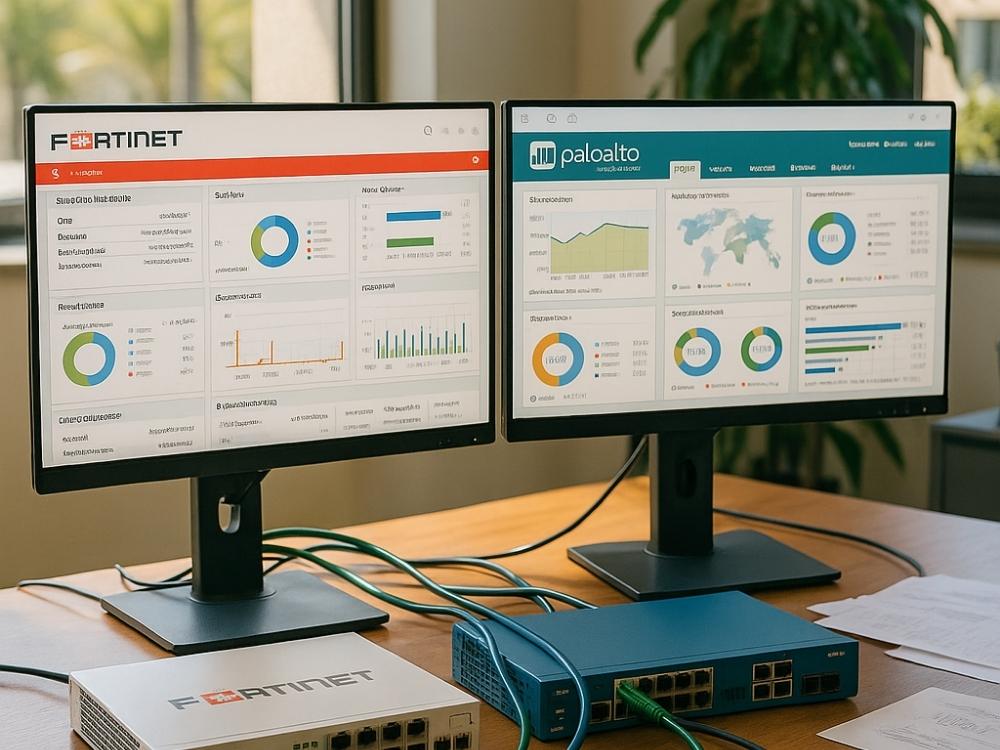
Yet many SMEs still rely on outdated or underpowered network security solutions. Choosing the right firewall is one of the most critical decisions an SME can make. And when it comes to leading providers, two names dominate the conversation: Fortinet vs Palo Alto Networks.
This guide breaks down the strengths, weaknesses, and real-world considerations to help Cyprus-based businesses choose wisely.
Fortinet vs Palo Alto: What’s Better for SMEs in Cyprus?
According to the ENISA Cybersecurity Guide for SMEs, small and medium businesses account for nearly 99% of all EU companies—and they’re often the most vulnerable to cyberattacks.
Key challenges for SMEs in Cyprus include:
Limited in-house IT staff
Tight budgets for security tools
Increasing compliance requirements (e.g., GDPR)
Remote and hybrid work setups
A growing reliance on cloud services
Local businesses are often targeted precisely because attackers know they lack dedicated security teams. Without proper protection, a single breach can cause financial loss, reputational damage, and operational disruption.
This is where next-generation firewalls (NGFWs) come in—and where Fortinet and Palo Alto enter the picture.
Fortinet vs Palo Alto: Why Fortinet Is the Better Fit for Cyprus SMEs
Fortinet is known for its balance of performance and affordability. Its flagship product, FortiGate, combines advanced security features with a user-friendly interface that makes it ideal for SMEs without large IT teams.
Fortinet Strengths
Unified Threat Management (UTM): Combines firewall, antivirus, intrusion prevention, web filtering, and application control in one system.
Secure SD-WAN: Ideal for businesses with multiple offices or remote employees.
Integrated Ecosystem: Seamless integration with FortiAnalyzer (analytics), FortiClient (endpoint protection), and FortiManager (policy management).
Strong Cloud Compatibility: Works well with AWS, Microsoft Azure, and Google Cloud.
Excellent Price-to-Performance Ratio: Fortinet provides enterprise-grade features at an SME-friendly price point.
Fortinet vs Palo Alto: What’s Best for Cyprus SMEs?
For SMEs in Cyprus, Fortinet offers both simplicity and scalability. It’s a solution that can be tailored to the size and needs of a growing business.
Fortinet vs Palo Alto: Why Palo Alto Offers Premium Security for Complex Needs
Palo Alto Networks is often chosen by larger enterprises and organizations with high compliance and security demands. Its firewalls are built for advanced detection and deep network visibility.
Palo Alto Strengths
App-ID and User-ID: Identify and control applications and users regardless of port or protocol.
WildFire Threat Intelligence: Industry-leading zero-day threat detection through a global intelligence network.
Advanced Logging and Reporting: Useful for compliance-heavy industries such as healthcare, banking, and government.
Cloud-First Strategy: Excellent cloud-native security tools for organizations adopting hybrid or multi-cloud infrastructures.
However, this level of security comes with a higher cost. Palo Alto firewalls can be more complex to deploy, require more configuration, and carry a steeper learning curve for IT teams.
Choosing between Fortinet and Palo Alto should start with a needs assessment. Ask the following:
What are our actual cybersecurity risks?
Do we have staff to manage a complex system?
How many locations or remote users do we need to secure?
Are we planning a full or partial migration to the cloud?
What’s our cybersecurity budget—short and long term?
If your business is primarily focused on reliability, cost-efficiency, and ease of use, Fortinet is likely the better fit. It offers strong protection without the high administrative overhead, and it scales easily as your business grows.
Palo Alto is best suited for organizations that operate in regulated sectors or face advanced persistent threats—and are ready to invest in long-term management and integration.
Local Expertise Makes the Difference
One of the most important factors in cybersecurity is local support. Even the most advanced firewall is only as good as the team deploying and managing it.
That’s where ACE Networks plays a critical role. As a certified Fortinet partner in Cyprus, ACE Networks offers:
These recognitions underscore the reliability of both platforms, but it’s the implementation and daily management that ultimately matter.
Conclusion: The Smarter Choice for Cyprus SMEs
If you’re an SME in Cyprus, the decision between Fortinet and Palo Alto should come down to your business’s size, risk profile, and internal IT capacity.
Fortinet is the clear winner for most SMEs: affordable, flexible, and supported locally.
Palo Alto shines in enterprise environments with advanced needs and bigger budgets.
Cybersecurity is too important to delay, and too complex to go it alone. The good news is you don’t have to.
Start the conversation with ACE Networks to evaluate the right security setup for your business. Whether you’re upgrading from basic firewall protection or starting fresh, expert guidance will save you time, money, and unnecessary risk.
Your network deserves protection that works—now and into the future.
The cybersecurity threats Cyprus businesses face is more serious in 2025 than ever before. From ransomware to phishing, attackers are targeting SMEs and large organizations alike. According to local reports, even airports, utilities, and government portals have been hit in the last two years. For business owners, ignoring IT security is no longer an option.
This article explores the top threats affecting Cyprus companies in 2025, why they matter, and how you can prepare. We’ll also show you where to get expert help and resources, explained as well in our Complete IT Services Cyprus Guide.
Top 5 Cybersecurity Threats Cyprus Businesses Face in 2025 (and How to Prepare)
2. Why Cybersecurity Threats in Cyprus Are Rising
The past years, cybersecurity threats in Cyprus are on the rise and there are several factors are making Cyprus a growing target:
Digital growth: More SMEs are moving to the cloud, creating new attack surfaces.
Geopolitical tension: Cyprus sits at a strategic location, attracting international cybercriminals.
Weak defenses: Many businesses still lack basic cybersecurity policies.
High-value data: Financial services, law firms, and shipping companies in Cyprus hold sensitive information.
The result? Cyberattacks are becoming more frequent and more damaging.
3. The Top 5 Cybersecurity Threats Cyprus Businesses Face in 2025
Phishing Attacks
Phishing remains one of the first and foremost cybersecurity threats Cyprus SMEs face. Criminals send fake emails that look legitimate, tricking employees into clicking links or sharing passwords. According to ENISA, phishing attacks are rising across Europe, and Cyprus is no exception.
How to prepare: Train staff to recognize suspicious emails and invest in email filtering solutions.
Ransomware
Ransomware encrypts company data and demands payment for release. In Cyprus, law firms and accounting firms have been prime targets. Paying the ransom doesn’t guarantee data recovery.
How to prepare: Regularly back up data, keep systems patched, and use next-generation antivirus solutions.
DDoS Attacks
Distributed Denial-of-Service (DDoS) attacks overwhelm websites or networks with traffic until they crash. In 2024, Cyprus saw multiple DDoS attacks targeting critical infrastructure (IndustrialCyber).
How to prepare: Use DDoS protection services and cloud-based firewalls.
Insider Threats
Not all risks come from outside. Employees—whether careless or malicious—pose serious IT security risks in Cyprus. Accidentally emailing sensitive data or reusing weak passwords can expose your business.
How to prepare: Enforce strict access controls and provide ongoing staff training.
Cloud Security Gaps
As more SMEs adopt cloud services, misconfigured settings and poor access control become serious vulnerabilities. Cybercriminals exploit weak cloud security to steal or lock valuable data.
How to prepare: Work with IT experts to configure cloud platforms securely and use tools like multi-factor authentication.
4. Compliance: GDPR and Cyprus Regulations
Compliance isn’t optional. Under GDPR, businesses that fail to protect customer data risk heavy fines. Cyprus also follows the EU’s NIS Directive, which requires stronger cybersecurity practices for critical industries.
Key compliance takeaways:
GDPR applies to all businesses handling EU personal data.
Regular IT security audits reduce legal and reputational risk.
Fortinet and similar solutions help meet compliance standards.
Cyprus is facing a surge in cyberattacks. From government portals and airports to SMEs, no organization is immune. For businesses, the question is no longer if they will be targeted, but when. The good news: solutions like Fortinet, combined with the expertise of local IT experts in Cyprus, can drastically reduce risks. This article breaks down the current threat landscape, why Fortinet is gaining ground in Cyprus, and how SMEs can strengthen defenses today.
Fortinet in Cyprus: Why It’s Gaining Traction
Fortinet in Cyprus and globally, is a leader in network security. Its FortiGate firewalls and integrated security solutions are now widely adopted in Cyprus through certified partners like GCC and IBSCY Ltd. What makes Fortinet stand out is its ability to combine performance with deep threat intelligence.
Why Cyprus businesses are choosing Fortinet:
Next-Generation Firewall (NGFW): Real-time protection against malware, ransomware, and phishing.
Unified platform: Network, endpoint, and cloud security all managed together.
Scalability: Works for both SMEs and large enterprises.
Compliance support: Helps meet GDPR and national security standards.
Need to compare if Fortinet or Palo Alto are the right choice for your business? Check out our recent article here
For SMEs that lack in-house IT staff, Fortinet offers enterprise-grade security without overwhelming complexity.
Cybersecurity Threats in Cyprus SMEs Face
Recent reports from national and EU cybersecurity agencies confirm a surge in cyberattacks targeting key sectors in Cyprus — including government portals, airports, utilities, and increasingly, private businesses. The threat landscape has evolved significantly, with attackers leveraging more sophisticated and automated tools to breach systems, disrupt services, and exploit data.
For SMEs (small and medium-sized enterprises), the risk is especially high. These organizations often lack the resources, expertise, or infrastructure to defend against modern threats — making them attractive targets for cybercriminals.
Key Cybersecurity Threats Affecting Cyprus SMEs:
1. Phishing Emails
Phishing remains one of the most common and effective attack methods. These emails are designed to look legitimate — often impersonating banks, suppliers, or even internal staff — tricking employees into clicking malicious links or entering sensitive information.
Trend to watch: AI-generated phishing emails in 2025 are becoming nearly indistinguishable from real correspondence, making employee training and email filtering more critical than ever.
2. Ransomware Attacks
Ransomware has evolved beyond simple data encryption. Attackers now exfiltrate sensitive files before locking systems, threatening to publish stolen data unless payment is made. This “double extortion” tactic poses a serious legal and reputational risk, especially under GDPR.
Real impact: A single ransomware incident can shut down operations, lead to client data breaches, and cost thousands in recovery and fines.
3. Insider Threats (Human Error or Malicious Intent)
Not all threats come from the outside. Insider threats — whether from careless mistakes or disgruntled employees — account for a significant portion of security incidents. Misconfigured cloud storage, weak passwords, and the use of unauthorized devices or apps can all open the door to attacks.
Key fact: Over 30% of reported data breaches globally stem from insider actions, according to industry reports.
4. DDoS (Distributed Denial-of-Service) Attacks
DDoS attacks overload websites, servers, or networks by flooding them with fake traffic. While these attacks may not compromise data directly, they can bring down systems and interrupt service delivery — especially devastating for ecommerce, online booking, or customer service platforms.
Local examples: Public service websites in Cyprus have already experienced such disruptions, showing these tactics are not just theoretical risks.
Why SMEs Are Especially Vulnerable in Cyprus
Many small businesses in Cyprus still rely on outdated software, minimal cybersecurity policies, and reactive IT support. Without dedicated in-house experts or advanced tools, they struggle to monitor threats in real time or recover quickly after an incident.
Common weaknesses include:
Unpatched operating systems and legacy software
Poor employee awareness or training
No formal incident response plan
Lack of multi-factor authentication (MFA)
Hackers see these gaps and specifically target SMEs, knowing the defenses are easier to bypass compared to large organizations with dedicated security teams.
What This Means for Business Owners
If you run an SME in Cyprus, now is the time to evaluate your cybersecurity posture. Even basic steps like employee training, using reputable endpoint protection, and setting up proper backup systems can significantly reduce your risk exposure.
Working with trusted IT experts in Cyprus who are familiar with local regulations and infrastructure can provide the expertise needed to implement scalable, affordable protection — before a breach happens.
Regulation & Compliance: The Cyprus Context
Cybersecurity isn’t just about stopping hackers—it’s also about staying compliant. Cyprus, as part of the EU, enforces strict rules under GDPR. The National Cybersecurity Strategy of Cyprus also outlines obligations for businesses to strengthen IT systems.
Compliance risks if ignored:
Heavy GDPR fines.
Loss of customer trust.
Reputational damage after a breach.
Fortinet in Cyprus is designed with compliance in mind, making it easier for businesses to meet local and EU requirements
Cybersecurity is a journey. Start with the basics, then build up with expert help.
Conclusion
Cybersecurity threats in Cyprus are real, rising, and costly. But SMEs don’t have to fight them alone. Fortinet solutions, combined with the skills of trusted IT experts in Cyprus, provide a clear path to stronger defenses.
What is Fortinet and how does it help Cyprus businesses?
Fortinet is a global cybersecurity provider known for its advanced firewalls, intrusion prevention, and threat intelligence. In Cyprus, SMEs use Fortinet to secure networks, protect data, and meet compliance requirements.
Why are more SMEs in Cyprus adopting Fortinet solutions?
Small and medium-sized businesses in Cyprus face growing cyber threats like phishing, ransomware, and DDoS attacks. Fortinet offers scalable, affordable, and reliable tools that don’t require in-house IT teams to manage.
Is Fortinet compliant with GDPR and local Cyprus regulations?
Yes. Fortinet solutions help businesses meet GDPR data protection standards and align with the Cyprus National Cybersecurity Strategy. Features include logging, encryption, and data control.
How do I find a Fortinet-certified IT expert in Cyprus?
Look for providers who are official Fortinet partners or hold Fortinet NSE certifications. They will have access to advanced support, tools, and training to configure your security system correctly.
What’s the difference between Fortinet and other cybersecurity vendors?
Fortinet offers an integrated platform that combines firewalls, endpoint protection, and cloud security in one system. This makes it more efficient and cost-effective than using multiple disconnected tools.






![Best Firewalls for Small Business Cyprus [2025 Buying Guide]](https://acenetworks.eu/wp-content/uploads/2025/10/BEST-FIREWALLS-.jpg)
![Best Firewalls for Small Business Cyprus [2025 Buying Guide]](https://acenetworks.eu/wp-content/uploads/2025/10/BEST-FIREWALLS--1024x1024.jpg)